
🏛️ Living & Dancing in Berlin: Your Home Away from Home
Moving to a new city—or even a new country—is an exciting milestone. At Balance 1 Academy, we don't leave you alone with the administrative challenges.
On this page, you will find all essential information regarding housing, our emergency accommodation, visa regulations, blocked accounts, and working in Berlin.
🏫 1. Housing & Balance 1 Emergency Accommodation
Finding a long-term apartment or shared room (WG) in Berlin can take some time. To make your arrival as smooth and stress-free as possible, we offer an immediate solution right on campus:
🛌 Temporary Emergency Accommodation at Villa Balance
Haven’t found permanent accommodation in Berlin by the time the program starts? We’ve got you covered! For your transition during the first few weeks, Expected to launch in October, we offer our students an affordable, temporary housing option directly on-site in our newly renovated shared room with kitchen and bathroom on the lower floor (featuring natural daylight via light shafts) of Villa Balance.
-
The Advantage: You live right where you train, get to know your fellow classmates immediately, and can search for long-term housing without time pressure.
-
Facilities: Comfortable sleeping arrangements, access to your kitchen, shower/WC facilities.
-
How to Book: Places are limited and will be coordinated directly upon receiving your official admission offer after your audition.
-
For Whom? Designed as an stress-free temporary solution for your first month(s) while you search for long-term housing in Berlin.
Booking possible on a monthly basis. -
Affordable Rates: Budget-friendly pricing exclusively for participants of our Professional and Intensive Programs.
-
On-Site Convenience: Stay right at the Academy, eliminate commute times, and connect with fellow dancers from day one.
(If you are interested in securing a temporary spot, simply mention it during your application process, space is limited!)
🏢 Long-Term Student Housing in Berlin
The Berlin housing market is highly competitive, but with patience and the right approach, finding a place is absolutely achievable.
Popular and well-connected neighborhoods among our students include Neukölln, Kreuzberg and Tempelhof, as well as Mariendorf, Schöneberg, and Prenzlauer Berg, all of which are very well connected to Villa Balance.
- The Flatshare (WG) Advantage: Most students in Berlin live in shared apartments, called a "WG" (Wohngemeinschaft). Since our graduates also pass their rooms down to the next generation of incoming students, in case they leave Berlin, feel free to ask if we have heard of any current internal listings.
- Important Security Notice: Please be aware that rental scams have increased on social media and housing portals. Never transfer deposits or rent in advance before you have personally viewed the room or are 100% certain the offer is legitimate.
Recommended Portals for Your Room & Apartment Search:
- wg-gesucht (The gold standard for finding shared flats)
- studenten-wohnung.de/ berlinovo.de
- Immobienscout24 (Section: Short-term rentals / "Wohnen auf Zeit)
- Immonet.de (student apartments)
- spotahome
- housinganywhere.com (very popular and safe for international students, more expensive)
🛂 2. Visa & Entry Regulations for International Students
Visa requirements depend on your nationality and the duration of your chosen program at Balance 1:
A. Citizens from EU / EEA & Switzerland
-
No visa required. You only need a valid national ID card or passport. After moving into your accommodation, you must register your address at the local Berlin Citizens' Office (Bürgeramt) within 14 days.
B. Visa-Free Entry (e.g., USA, UK, Canada, Australia, Israel, Japan, South Korea, Brazil, New Zealand)
Citizens of these countries can enter Germany without a visa for up to 90 days. The required steps depend on your program:
-
🏛️ For the 3-Year Professional Dance Education:
You enter visa-free and submit an online application for a residence permit for educational purposes (Aufenthaltserlaubnis zum Zweck der Ausbildung) with the Berlin Immigration Office (LEA) within your first 90 days.
-
⚖️ Legal Protection (Fiktionswirkung): Once your application is logged before your 90-day tourist status expires, your legal stay in Germany is automatically extended under German law (§ 81 Section 3 AufenthG). You are fully permitted to begin your studies seamlessly while awaiting your official appointment.
-
Visa Category: National Visa / Residence Permit for Vocational Training (§ 16a AufenthG) or Higher Education Studies (§ 16b AufenthG).
-
-
🚀 For the 5-Month Dance Intensive Program:
Strong Recommendation: Please apply for your visa at the German Embassy in your home country before traveling to Berlin!
-
Why? Processing times at the Berlin Immigration Office currently take 3 to 6 months. For a 5-month program, your studies would be over before the authority finishes processing your application.
-
Recommended Visa Categories:
-
Further Training Visa (§ 17 Section 2 AufenthG): Specifically designed for professional, vocational, and artistic further education.
-
Working Holiday Visa / Youth Mobility: Available for citizens of partner countries (e.g., Japan, Australia, Canada, New Zealand, South Korea, Israel, Chile, etc.).
-
Visa for Educational / Training Courses (§ 16f AufenthG): For non-degree intensive courses and artistic preparation.
-
-
C. Countries Requiring a Visa Prior to Entry
-
If your home country does not have a visa-free agreement with Germany, you must apply for a visa for educational purposes prior to your departure at the responsible German Embassy or Consulate in your home country. You will need your Balance 1 Education Contract and official proof of financial resources.
💰 3. Financial Proof: The Blocked Account (Sperrkonto)
To obtain and renew your residence permit, German authorities require official proof that your living expenses are fully secured for your period of study.
-
Required Benchmark: The required amount set by the Federal Foreign Office is currently approx. €934 to €992 per month (approx. €11,208 to €11,904 per year).
-
⚠️ Important – Annual Renewal Required: For the 3-Year Professional Education, you must present this proof of funds every single year anew to the Berlin Immigration Office (LEA) in order to extend your student visa for the subsequent academic year.
-
How to Open: A blocked account can easily be set up online prior to your arrival through officially recognized providers such as Expatrio, Fintiba, or Coracle.
💼 4. Working Alongside Your Training: Tax-Free Earnings & Limits
As an international student, you are legally allowed to work part-time alongside your full-time dance training to support your personal budget (e.g., during evenings or on weekends):
-
Tax-Free Income Limit (Minijob): You can earn up to €556 per month (or €6,672 per year) completely tax-freeand exempt from social security contributions.
-
Work Hour Regulations:
-
Under a vocational/student visa (§ 16a / § 16b AufenthG), you are permitted to work up to 140 full days or 280 half days per calendar year.
-
Under a Working Holiday Visa, regulations regarding working days are even more flexible.
-
- Letter of Acceptance: Your signed training contract and the official certificate of enrollment from our academy.
- Proof of Financial Resources: You must prove that you can cover your living expenses in Berlin for the first year. The statutory minimum amount is currently €992 per month (or €11,904 per year). This is usually proven via a so-called Blocked Account (Sperrkonto, e.g., through providers like Expatrio, Fintiba, or Coracle) or through an official declaration of commitment (Verpflichtungserklärung).
- Health Insurance: Simple travel health insurance is not sufficient for a long-term stay. You will need a special German or international student health insurance policy.
- Passport & Photos: A valid passport and recent biometric passport photos.
- Letter of Motivation: A personal letter explaining why you want to complete your professional dance training specifically in Berlin and at the Balance 1 Academy greatly increases your chances at the embassy.
- Important Note: Please understand that asking us to call the German embassy to "put in a good word" for you is counterproductive. Consulate staff are extremely busy and explicitly request not to be contacted by phone regarding application statuses. Interventions by educational institutions or universities are not welcome and will not accelerate the processing of your application.
Language Requirements: Do you need to know German?
Classes at Balance 1 Academy are taught bilingually in German and English. A good command of English is therefore essential. If you’d like to live and dance in Germany, we recommend that you acquire a basic knowledge of German beforehand. In their day-to-day life at the academy, our international students usually learn German very quickly through close contact with their German-speaking classmates.
🐻 Berlin: The Creative Epicenter for Contemporary Dance in Europe
When you move to Germany’s capital for your professional dance training or the Dance Intensive program at Balance 1 Academy, you dive straight into one of the most vibrant, creative, and inspiring cultural hubs in the world. Berlin has always been a powerful magnet for artists, dancers, and free spirits from every corner of the globe. Despite the global rise in living costs, Berlin maintains its unique charm and remains one of the most livable and stimulating cities for young creatives.
Berlin is globally recognized as one of the most vibrant capitals for contemporary dance. Beyond your daily classes at Balance 1, the city offers an unparalleled artistic ecosystem: from major institutions like the Staatsballett Berlin and Radialsystem to independent production houses and international performance festivals.
Studying at Balance 1 means you don't just train in the studio—you live right at the heart of Europe's creative pulse.
Berlin is a cultural capital, a nightlife capital, and a fashion hub all at once—yet it is surprisingly green and relaxing. After an intense day of training, you can unwind in countless parks, take walks in extensive forests, or go swimming in the clean lakes surrounding the city. The characteristic, lush avenues and thousands of street trees shape a green urban landscape. It is the perfect environment to clear your mind, gather new inspiration, and unfold your artistic potential in Contemporary Dance.

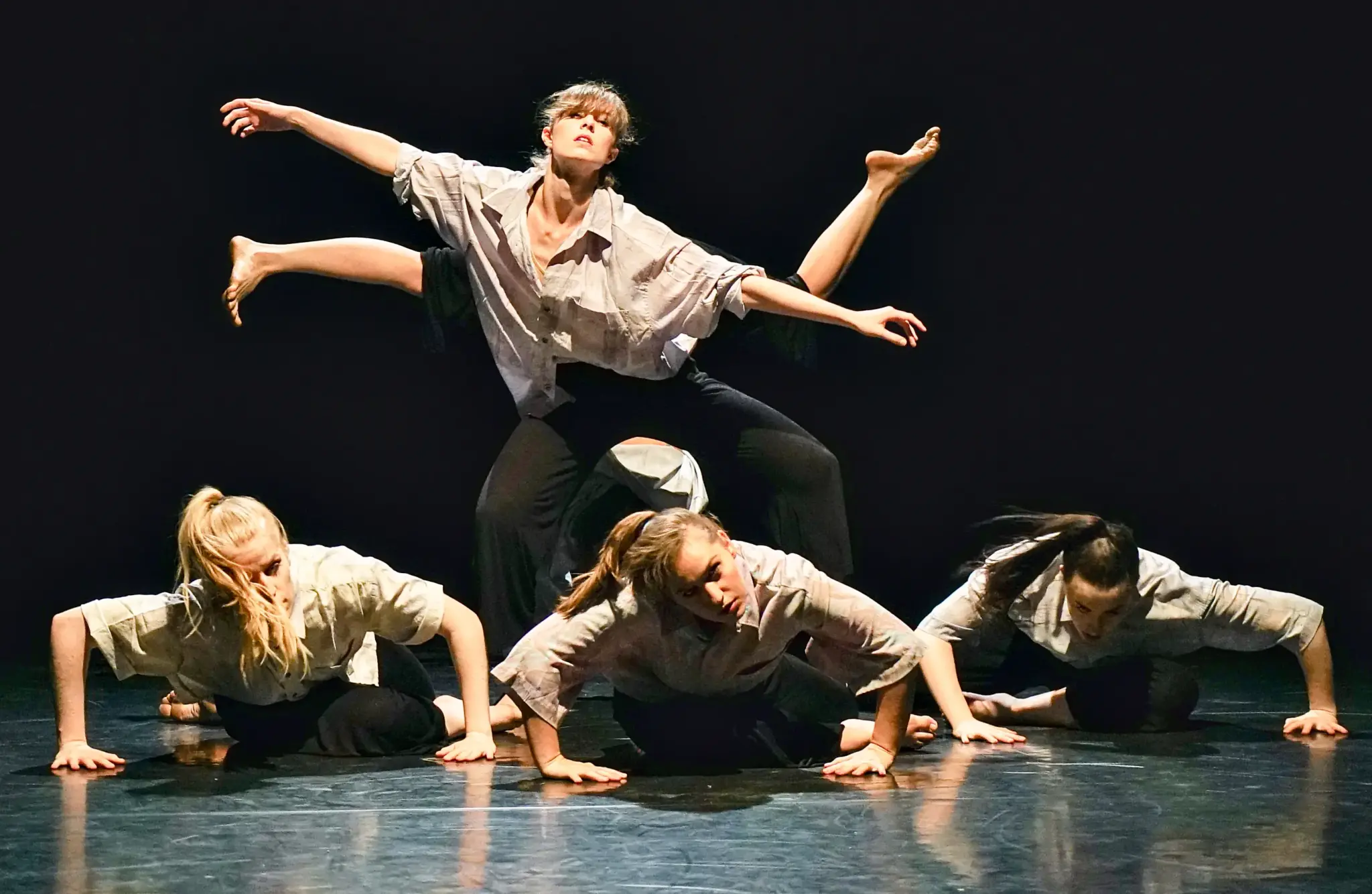
👋 The Independent Dance Scene as Your Perfect Learning Environment
🎟️ Cultural Diversity in Berlin
The cultural offerings in Berlin are extremely diverse. The city has about 200 museums, of which the Berlin Museum Island, a UNESCO World Heritage Site, is the largest museum ensemble in the world. Furthermore, you will find 400 galleries, eight major symphony orchestras, three opera houses, about 150 theaters and stages and more than 90 cinemas.
The oldest musical theater is Berlin's famous Friedrichsstadtpalast with one of the largest theater stages in the world. Musicals are also performed in the former Theater des Westens. In addition, you will find cabaret stages, children's theaters and Berlin's independent venues.
🎭 Dance & Experimental Art
The city’s cultural landscape is inexhaustible: with around 200 museums, three opera houses, and 150 theaters, your free time will always be filled with inspiration.
The famous Hebbel am Ufer (HAU) showcases groundbreaking contemporary productions across its three stages (HAU 1, HAU 2, HAU 3). Venues like Dock 11, Halle Tanzbühne Berlin, or the Uferstudios—where we traditionally present our Balance 1 Dance Performances—will become core milestones of your artistic journey.
🍱 Culinary Trends & The Berlin Way of Life
Food & The Iconic "Späti"
Berlin is world-famous for its multicultural, highly affordable, and extremely vegan-friendly food scene. And for quick shopping at any hour of the night, you will find Berlin’s legendary "Spätis" (late-night convenience stores) on almost every corner, serving as a corner shop and local meeting point in one.
In addition to the normal supermarkets, there are markets of all kinds in many parts of Berlin: market halls, weekly markets, organic markets and flea markets, where it is worth shopping. Of course there are also international supermarkets e.g. with Asian or African specialties.

